Thursday, 2 February 2017

Creative innovation and entrepreneurialism, working with the BBC, Session 2.

Thinking and reflections on notes taken at the BBC, creative innovation and entrepreneurialism Lecture, Wednesday 2nd February:
This part of the talk provided an overview of the design research and reflective practice together with user experience and design methods conducted by the BBC.
The conference was given by:
 Kelly Lothbrook-Smith, Senior Design Research Consultant;
together with Tina Connolly, Senior UX Designer, CBeebies;
and also Laura Fletcher, UX Designer, BBC content discovery.

Kelly started the lecture by explaining that the "user experience" (UX) is a very overused phrase within contemporary media which just about means anything you want it to be regarding how people perceive things!

Kelly's background is in psychology, having studied the subject through university and as a therapeutic practitioner. She was then invited to join the BBC to assist them particularly with design research on the BBC iPlayer.

The first task but we undertook was a little icebreaker where collectively we were asked to record each of the presenters and their interaction with how they engaged in the simple act of eating yoghurt. This was to (or “intending to”) potentially redesigning the packaging of this product, and to try and articulate how the product taste is better than anything else on the market. From a consumer's point of view, this would include recognising, choosing, buying and consuming this "revolutionary taste experience".

Kelly's explanation of marketing reminded me of a story that I have heard before and the idea that "when it is not yours, don't say that your baby is ugly". In other words, Kelly was touching on the idea of Confirmation Bias. This is a direct link to the psychological concept that there is a tendency to favour information that confirms an individual's belief and hypotheses.

Therefore, it is essential that whenever we are conducting research, it is of particular importance that unedited research results are fully presented. We need to ensure that we never inadvertently inject our confirmation bias into research results.
A phrase that is often used is

"design like you are right…
                           But test it like you're wrong."

Use research as inspiration!
A useful meta name or abbreviation when approaching research might be considered as "what is the P.O.I.N.T.!"
Where;
Problem:         is defined as a problem with the current approach and what it is you're looking to investigate.
Opportunity:  how can we change our approach by using appropriate research?
Insight:          what we know already, how do people behave normally?
Needs:           what are the specific requirements of the research? What are our intended outcomes?
Themes:        through which themes can we engage with the general public or the target audience to carry out our research?
[We then conducted the yoghurt test, where each of the conference speakers individually went through the procedure of selecting a yoghurt, peeling back the lid in various ways, and then eating the contents. This was completed with different ways in which to dispose of the packaging.]

Part one: Research Fundamentals.

1) what do people need?
2) what people want?
(If we think of these as desirables.)
3) can they use the things that we give to them? Furthermore can we "delight" our users, without overwhelming them?
We can conduct research of user experience (UX) usually through the following interventions;
  • User interviews
  • focus groups
  • ethnographic studies
  • diary studies
  • email surveys
  • competitor analysis.
Also, there are further research models that we may choose to use, such as;
UX blueprint diagram; journey mapping; user stories; personas;
analytics review; expert reviews; web surveys; system user acceptance et cetera et cetera.
Research is always useful, but it must always be balanced against:
cost: time; the stage of the project; user availability; the questions that you are asking!
There is a theory by the NN group that suggests that you only need to use five people to test the product to get approximately 85% of the expected failures and answers. If one was to draw a graph of user problems found: versus number of test users, the optimum number of test subjects at 85% can be shown as follows;
See the website HTTP://www.NNGROUP.com/articles/why-you-only-me
Active research is valid only when
  • you are asking the right questions
  • you employ active listening
  • you engage with efficient problem-solving
It is simply wrong to test ideas in silos: however, it is imperative to contextualise things. Beware of Digging into a Rabbit Hole.

Part two: Listening!

One of the fundamental qualities of effective research requires the researcher to be an active listener. Questions, right questions are what is important.
We listen to some examples of radio interviews; some are good, and some are bad! The good ones tend to employ the following steps;
Step one) establish rapport; get down/get up to the respondents level. Talking a secure manner and make the interviewee at ease.
Step two) Ask reasonable questions that are open! Use Rudyard Kipling's classic aide memoir, I had six honest serving men they taught me all I knew, they are what and how and where and when and then finally why and who.
Step three) allow the respondent to go off on tangents and talk about what they want to talk about, but gently give them time to answer.
Step four) steer the conversation back from any tangents they may wander down, steer them through the context as a guide, but do not force answers.
Step five) everything is useful. Record what the respondents have said and how they say it. These sometimes have insights into what the respondents might be thinking, even though, at first, some statements might be confusing.
Step five) be interested in listening. Lean forward and make eye contact. Nod your head regularly, try to mirror the respondent's mood and body language as appropriate. Overall you're trying to convey a sense of warmth and engaged interest.
Step six) replay some of the sentences the respondent has given, this helps with mutual understanding and shows that you are listening. Qualify and ask for further meaning if there is an unusual word that may be used. In this case, only ask "what do you mean by that word XYZ". It is important to ask these questions with a sense of warmth, gentle enquiry. Do not intimidate the respondent by exclaiming "what do you mean by that" on its own, as this can be misconstrued. Ask specifics.
Leading questions that are closed (that is issues that usually have an answer of yes or no) are extremely dangerous as they not only close down respondent if asked to quickly they become intimidating. The interviewee is likely then to give answers that they think you as a questioner wants to hear, rather than their true feelings or desires et cetera.
Keep questions open.
And finally make sure that the languages appropriate to the respondent, regarding intellectual capability, age groups, context, and avoid eccentric or esoteric questioning that might be difficult to understand.

Active listening;
shut out distractions, pay undivided attention, lean forward and observe the respondent body language.
Start with open questions, such as; "tell me about…" Or perhaps "could you explain a little bit about…"
Provide effective prompting; especially when the respondent is stuck for words

Planning;
  • Flow-explain introductions, warm-up, context. A logical order of themes. And on a positive note.
  • Depth-include key prompts and probing questions at the appropriate time.
  • Layout-keep the conversation uncluttered, well spaced, and for written enquiries, make it understandable at a glance.
  • Focus-ensure that the key research objectives are covered.
Make sure you have a plan!

Methods:
Guerrilla Testing: this is a phrase that is becoming more popular, and relates to direct approaches to people when you find them within their natural habitat.
Get into the user's domain, a cafe or the street; into their office's, garages and workplace if it's permitted. Another useful place to find respondents is in areas where they are waiting and don't have much to do, such as stations, bus stations, clubs, queues for events and so on.
Catch people when they're killing time.
It works well when you work in pairs together.
Always give the respondents and incentivisation as a thank you, something simple such as a bar of chocolate or sweetie: but never use this as a bribe to influence.
Guerrilla testing is a good way to get "quick data".

Lab Testing: - this is testing in a controlled environment.
-The best way to achieve "lab" interaction is through the use of multiple cameras, with facilitated prompts. It is necessary to observe respondents in great detail, seeing their manner of address, body language and overall movement: et cetera. Watch their every pause, every utterance. With the proper reflective analysis, a whole brain dump of ideas can come from this work.
Learning should be then applied to future lab tests. Any sessions of lab testing should then include iterations of what has been learned from previous meetings. The objective here is to keep improving the quality of the research.
However in lab environments exercise caution, particularly be on the lookout for "double negatives" or "double positives" which can blind your results. These are often seen when interviews are being conducted where there are additional people, superfluous to the exercise within the room. The respondent is psychologically influenced by what they perceive those other people might want to hear.

Remote Testing: - This is dependent on the technology that is available to you and is often a way of helping a researcher find "the journey" that the user might have when interacting, especially with a piece of software.

There are many models of remote testing that are available on the open market to the researcher such as for example:
  • Userzoom. 
  • Optimal Workshop: 
  • loop 11: 
  • user testing.com: 
  • WhatUsersDo
One of the latest forms of research for visual feedback is a method known as "Eye Tracking" which is a new type of analysis in which users can be critically observed.

Top tips:

Always remember that research is not a test! Any answers are right! There is no right or wrong answer from a respondent.
Silence is golden! Listen to the Focus!
Avoid all bad language! Equally, don't mirror or replay bad words!
Plan! Make a structure.

Good intentions:
  1. Avoid recruiting experts. There will just only tell you a narrow band of answers.
  2. Test small, test early, test often.
  3. focus on what needs fixing (or what needs refining)!
  4. Rotate the order of tasks and questions. This keeps people fresh and stops the effect of priming.
  5. Your prototype's fidelity is what matters, but it is not critical. When creating a prototype, it does not need to be perfect. Anything can be a prototype, providing that it just needs to be representative. It is a model.
    Prototypes can be remade, readjusted and re-formed. Get as much "representation" as possible into a prototype, rather than just features. When using whiteboards or display walls, use colour coded sticky notes to help navigate.
  6. Isolation; be aware that the presence of other people can influence the outcome, even if they don't speak or give answers at the time. People sometimes give answers because they think they "should" choose appropriate solutions, based on social hierarchy and other influences when in the presence of other people.
  7. Never take notes on what people are saying, but take notes on what they are doing!
Where to next?
Note taking: cover key themes and research objectives.
Why does one observe? What people say and do are very often different. Observations actually see what happens in reality, rather than relying on self-description, which is often biased (remember confirmation bias?).
  • Analysis: there is no magic or science in research.
  • Organise your findings and issues into key themes or further research questions to answer.
  • Take
  • Include background details, methods employed and so on.
  • Provide coding: create verbal tags; metadata tags to group research together.
  • Create themes: use the metadata tags of coded data to develop ideas.
  • Theorise: -build a hypothesis to take forward for further work so that new ideas can come out from your research.

And finally…
Always remember accessibility and colour blindness. Always consider the disability discrimination act in your activities, but also bear in mind that there are other motor based limitations, that are sometimes hard to qualify and quantify. For example, consider mums with babies! Invariably they only have one hand free to facilitate tasks if they are carrying a baby!


Wednesday, 1 February 2017

Building the team - Rotor Gallery Exhibition, - team activities.

In the reflection of a discussion with Dr Rowan Bailey, (held on Wednesday, 1 February), we were asked to consider how we could stage discussions in contemporary art practice, - through the reflection and debate of topical film. It is intended, therefore, that on future Wednesdays, the film will be screened at 5 PM. After watching the film and making important notes, with the subsequent period of reflection, we will then have a group discussion about the findings of this movie.

Dr Bailey outlined the importance of our maintaining of the blog. Our individual thoughts can be captured as a process, and to develop how we might align our work within current contexts.

It was also reminded that the website we are to grow, as a group, should contain critical research in the following areas;
1) artwork and curatorial thinking together with audience experiences. 'Proper' qualitative research.
2) study and research of cultural awareness; how our research is targeting specific groups.
3) execution. Ideas generation and how we are mapping out to create productive artefacts.
4) an exploration of the social (and Commercial if relevant) benefits of having done this research.

It is important for us to consider how we interpret the module criteria, as this should continually be evidenced, both in the individual blogs that we create and on the team website.

It is also equally important to allocate roles and responsibilities for each of the team members as soon as possible!

In our case, option two, assisting with the Rotor exhibition, we must remember that we have an opportunity to pitch our ideas to Dr Liam Devlin on 1 March!

-------------------------

And now on to what we need to do!

A further meeting in the afternoon of Wednesday 1st, provided me with the following thoughts and notes:

There seems to be a habit of some people within the team of continuing to talk whilst others have the floor. This is really frustrating from a notetaking point of view, but it is also very difficult for everybody to be working on the same page when little sub discussions take place.

I think it might be appropriate to suggest some meeting rules that should be observed for mutual respect and group understanding. Hopefully this will improve cohesiveness within the team and engender a willingness to work with all members, not just a select few or preferred friends.

Rant over:

We need to set up somebody to help in the recording of the setup and installation next week. Tim agreed to attend, having already established that the gallery site technicians do not work on Mondays and Tuesdays, therefore Tim will attend the gallery next Wednesday, 7 February.

Following on from Rowan's suggestion, that we need to set up three sub- teams for areas such as 1) pre-research and customer satisfaction
2) photographers, audio and video recorders, together with web implementers.
3) archivists.

How will we manage the channels of communication? How will this start to work?

Have we considered, 1) are the times of the events appropriate?

Daniel Ainsworth agreed to write up what the recording team needs to do in order to capture effective material to include in the web site. (I have called him the "creative director", therefore).

Alex Oddy can describe what is required for specific photographic shots, of whom we need portrait of, what we need to photograph and when et cetera.

Chelsea Horan suggested: "as we have similar skill sets within the team, rather than everybody turn up on the same day, we could perhaps bid for which day we want to attend. We can individually select what we want to do such as photograph, video and so on, then who wants to do the editing afterwards?" Chelsea suggested that she would set up a "we join in" website for each of the events?

We urgently need to set up a first meeting:

Within this first meeting I would advise that we agree our rules of engagement, not only at future meetings but also at each of the events.
Agree rules of common courtesy where only one person can talk at a time!
Develop themes and ideas for research and also as headlines.
Some of these ideas we may need to contain, others we need to perhaps park until a future occasion.
Once we have the general tasks identified, specific details can then be applied later, but all of this needs to be captured, documented and placed on our website.

Date of next meeting; Wednesday 7th of February, after lunch.

Tuesday, 31 January 2017

Creating the Archive - Discursive Documents - Thinking about how we set up a project.

In thinking about the discussion that we had with Dr Liam Devlin last week, the new Huddersfield gallery exhibition called "Discursive Documents" which opens on 11 February 2017.  He described it as an exhibition that challenges the idea of photographic practice, to situate the practice of "what was there" into a new form that is "what is possible".

This is a philosophical construct to facilitate that idea through six artists work. Each of these six artists will be paired towards three themes. Each theme is intended to allow a viewer to place oneself between the two artists in their interpretation of work, to situate the viewer as a kind of fulcrum or axis.

The three themes are as follows;

1) Sieba Curtis and Alex Baldea. In their exhibition, they will be looking at the plight of refugees in the current context. The two photographers/artists deal with the subject in two different ways. In the case of Curtis, he provides access to this issue through the notion that refugee groups are usually considered as masses, and his desires to get away from that notion and engage with the individual. For example, Dr Devlin mentioned the recent case of a refugee hiding in a tanker full of talcum powder (magnesium oxide). The irony is that it is virtually impossible for a refugee to cross borders, whereas a commodity, such as talcum powder, is able to cross borders without any impeachment.

In the case of Alex Baldea, he chooses to get his photographic images and the references through the refugees own photographs. He does this by visiting refugee centres throughout the world and literally gives cameras to these refugees. He then specialises in taking a point of view, such as those images created by children, or single mothers, or fathers perhaps (et cetera). The photographic and artistic output, therefore, becomes a multi-vocal point of view.

2) Richard Mulhern and Richard Higginbotham. Photographic Representation.
In this theme of the exhibition, Richard Mulhern explores how we unconsciously regulate our behaviour within society. For example, we always walk on the curb, we know that we need to do that to stay safe! We don't blindly go walking into the middle of a dual carriageway. Mulhern engages with these ideas by trying to use photographs to show how subconsciously we abdicate our behaviours.

Similarly, Richard Higginbottom, whose photographs are explicitly within the city of Manchester, are in response to a piece of text written by Michel de Certeau, and his book "Walking in the City" (2006): seeing and knowing.
Higginbottom encourages the viewer to make connections that wouldn't normally be connected. The images and pictures are taken from different reasons, both are still photography. De Certeau suggests he can see over the whole city from the point of a high Observer, and in his case, while standing on top of the World Trade Centre in New York, Manhattan. He suggests that it is possible to know the city; however his book describes that in reality, it is impossible to take this helicopter view and gain some sort of understanding of the minutiae, because it is a seething mass of possibilities.

3) in the third theme, the exhibition will explore objectification of the female body, through the work of Sarah Eyres, and Leila Sailor.

Sarah Eyres explores this issue through her objects, for example, a collection of wigs (false hair). Her artefacts are usually moving images, photographs and gif files.

Leila's however, explores objectification of the female body through a mannequin. In fact, the manikin is a cheap plastic blow-up doll whom she calls "Dolores". With this goal, she suggests a kind of life force by slowly inflating and deflating it, whilst videoing the doll, and then finally at the end of her video she decapitates it.

Therefore there are three different debates.

We need to think about how we are going to archive all of this work and record it. There is not much time as the exhibition opens on 11 February, less than two weeks away. However, the official opening night and preview will be conducted on 16 February (Thursday).

And then we move on to the events which we will be responsible for. Each of these events will take a similar format and will commence at 2:30 PM in the afternoon and continue for approximately 2 1/2 hours until 5 PM.

The first event will be on 2 March, this will comprise of a short talk by the artists, and then a form of response through invited guests. In the first event, a refugee will be the responder, and a panel style discussion will then ensue. Therefore a practitioner, either Curtis or Baldea will be present to defend his position.

The second event will take place on 23 March. The former will follow the same as the first event with Richard Mulhearn and Richard Higginbottom both being in attendance.

The third event will take place on 6 April with Sarah and Leila. Again the same format as above for the first two events.

While the control of the event is likely to be pretty much up to the event organisers (group B of our team), the suggested format will be to look at the exhibition and work displayed and then open the debate which will also be recorded (again by our team).

The objective of our group engagement is to ostensibly help Dr Liam Devlin;

  • to document & record through audio and video,
  • to create a public archive/website and or both,
  • to plan host develop and manage the complete closing event on 4 May 2017.

With regards to this closing event, it is intended that a contemporary dance team who will be choreography by Gerry Turvey, and the dance group will provide an interpretation of the whole exhibition which we will also be expected to record.
Dr Devlin would also like us to re-present a kind of mash-up of the entire show at the closing event.

Conclusions:


  • we need to consider how we curatorial coordinate and capture all of the material
  • think how we could develop a publication of the debate
  • discuss and document the effects of the exhibition.
  • Record interviews and create reflective material and writings
  • include any conclusions and aspect of the debate that may need further explanation.
  • We therefore urgently need to manage ourselves and organise who will do what?
  • Who will do the video?
  • Who will manage and develop the website?
  • Who will conduct interviews with the artists?
  • Who will film the exhibitions and photograph them?
  • Who will manage the audio recording of the above interviews?
  • At the closing event, the mash up and become something to create further debate from itself perhaps? Ultimately this event is intended to provoke ideas.

Sunday, 29 January 2017

Creating order through chaos...

We are now into the beginning of week three of our module for innovation and entrepreneurialism, and I am finding the exercise (option two of the module) very stimulating. Working with a group is always interesting to me, as I enjoy watching the interactions, and psychology of individuals coming through.

The group to which I am attached has been tasked to set up a website, in response to an existing exhibition that is about to launch the Huddersfield Gallery, Huddersfield in early February. This does not leave us much time to set up and develop what I assume to be a public facing website.

Thankfully we had the opportunity to speak with the curator of the exhibition, Dr Liam Devlin, who is one of the tutors, I believe the course leader, for the photographic department of the School of Art, Design and Architecture. We were therefore able to ask a number of questions appertaining to the exhibition and to seek clarification.

I found it interesting that prior to the meeting with Dr Devlin, I had already prepared 10 separate questions to ask him about his view of success, academic scenarios, sequences of events, the closing event, how we might expand the show, who would we be asking to generate debate, funding and approval, marketing and promotion, a list of stakeholders, and how do we engage with additional agencies, et cetera. I was therefore surprised to say the least, that my peers in a team of around 12 other students had not prepared much, if anything, in the way of questions!

Nevertheless, I appreciate that I have had many examples of similar commercial engagements in my personal past, and so I felt it's appropriate for me to help to steer the group in how it is beginning to form into a collective team.

Now that we have had our initial contact meeting with Dr Devlin, I have started to make sure that the various meetings that we have already engaged with our properly minuted. I have also transcribed the interview with Dr Devlin in its entirety, and created a Microsoft office 365 SharePoint for all the students, both in group A, those who are building the website: and group B, who are responsible for creating the final event, and archiving the outcomes. The SharePoint facilities that the University is able to provide are a really useful tool that I am able to use for complete collaboration.

Whilst I am conscious that the group is still not in a cohesive state, I am always mindful that it takes time for the individuals to establish some sort of rapport with one another, together with the mature working relationship. This always takes time, and patience, thankfully I have in bucketfuls!

As a democratic way for each of the students to take their own responsibility for certain actions, I have started to develop a list of roles and responsibilities which I will present to the group at our next meeting on Wednesday, 1 February.

Following that meeting, together perhaps with input from the lecture that we have that day with the BBC, we can start to develop a stronger team structure and organise ourselves more proactively?

Saturday, 28 January 2017

Experimental photography, a lecture by Stella Baraklianou.

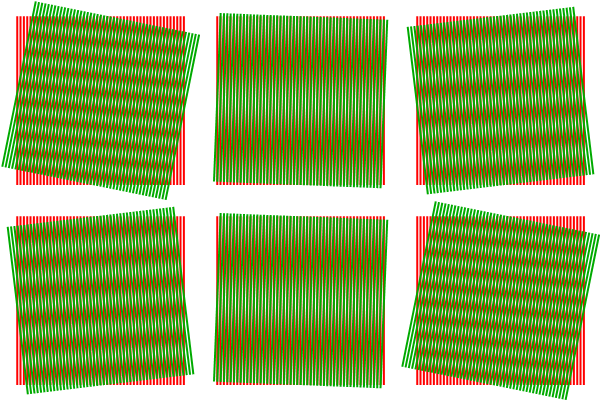
Experimental photography can generally be discussed and termed as "anything that is outside of the ordinary."... In this lecture, we will explore the idea of "the moire" (this expression is taken from a French textile method and is pronounced 'M-war-ey').

In essence, the description of moire is, an overwhelming interference of meshes, concentric rings, grids and so on that are overlaid on one another, so as to create an optical pulsation.
The artist Liz Deschenes exploits this, but instead of using digital techniques she uses analogue, camera-less, traditional film techniques, in other words, photo-grams.

https://www.sfmoma.org/watch/liz-deschenes-on-her-cameraless-photography/

The effect of changing the angle of meshes. Image
This moire effect, however, is an enemy of digital sampling. Because when a digital photograph is taken of certain items, say for instance a mesh drawn on a television presenter's clothing or suit, then depending on the speed of sampling within the digital camera, a moire effect may be produced when the photograph is replayed. This occurs especially on television. However, most digital cameras have what is called "anti-aliasing" filters to actually stop the moire effect.
Liz Deschenes work is all about exploiting and playing with the viewer's perceptions. This artist is playing with the experience of understanding and exploring the unintended.

Stella Baraklianou also investigates similar themes. In her recent international exhibition, in Banff, Alberta, Canada, where she was the artist in residence, Stella experimented with the properties of the material mylar, where it was used as a reflective substrate and is a sculptured reflector of both silver and gold. (This reminded me of some of the work that I have seen before by Joseph Kosuth).

Stella's enquiry was… How are these installations going to manifest themselves together with the ceramics, the tassels and the everyday objects?

By creating abstract "projected stage sets" as she called them, she was able to create new sculptures. The idea of light mirroring the piece in the centre of the stage set, changing the refraction and reflection of light to become an unknown projected object.

Clearly, there are two sides to the mylar sheets, one that stellar terms as a "cool" side and the other a "warm" side. These two sides of the mylar different effects. This has led to Stella coming up with the phrase of "Constructive Reversibles".

Stella has more recently displayed her art at the "Photography Is Magic" exhibition and also at the "Aperture Foundation" in New York in July 2016. At this event, the curator of the Photography Is Magic show was Charlotte Cotton. Further exhibits of refraction were provided by Sonja Thomsen and other artists, the website can be found here.  http://aperture.org/shop/photography-is-magic-3340/

Conclusions;


  • the idea of using the moire effect is an interesting concept.
  • My own ideas of trying to visualise the peregrines perception could possibly incorporate the moire effect?
  • Further studies into visual optics of other animals is going to be useful
  • Already reading the work by Tom van Dooren entitled Flight Ways: Life and Loss at the Edge of Extinction, and in particular the symbiotic relationships that humans have with other birds, and in this book, circling vultures and mourning crows provides good reading material.

Thursday, 26 January 2017

Innovation and Ideation. A Workshop with Auntie Beeb...

In this module of creative innovation and entrepreneurship, we were lucky enough to be able to attend the workshop which was held by members of the user experience team at the British Broadcasting Corporation (BBC).

There will be three workshops over the next few weeks, and these will be attended by;
Paul Crowley, Head of User Experience:
Dan Ramsden, Director of Creativity:

The three workshops will cover;
A) ideation; that is, coming up with ideas.
B) testing; validating the ideas and finding assurance through screening.
C) presenting; pitching to customers and selling your idea.

The BBC has always been the front of commercial communication, and as such, they adopt some methods to help them both facilitate and generate new ideas.

A presentation was given and referred to the work of Prof Eddie Obeng, concerning the difference between knowledge and learning.
https://www.ted.com/talks/eddie_obeng_smart_failure_for_a_fast_changing_world
Filmed June 2012 at TEDGlobal 2012

Eddie Obeng: Smart failure for a fast-changing world


Our ability to learn has been outstripped by the amount of knowledge that is available to us. We, therefore, live in what is called a "foggy environment" and this was articulated through a simple quadrant table as follows:


In this sense, the BBC suggest that the only way to deal with the wealth of information that surrounds us is to what in their words is a mantra for their group which is "run confidently into the fog."

In a way what is being said, is to avoid over-planning. In my case it's about avoiding the Gantt chart and thinking from a fresh point of view;


To have an excellent idea it takes lots and lots of bad ones first. We learn from our mistakes better than we learned from doing something correctly once. The great ideas that have emerged in the last 500 years, in fact in the last 200 years since the Enlightenment, have usually been a product, even a by-product of many many years of struggling failure.

Let's explore the idea of divergences to convergent to divergent and convergent thinking.


We can talk about this as four separate steps.

Start as an "explorer."
engage with the outside world to find stuff that interesting, be a collector but don't judge anything that you've witnessed or collected.

Then become "an artist."
Turn the stuff that you have found into other stuff by combining them. Just create things, but do it without any constraints!

Then become "a judge."
it is in this mode that you critically evaluate your ideas and start to find out through verification and testing what actually works or is likely to work.

Finally, make the step to be "a warrior."
In this step you press ahead regardless with your chosen ideas beating your chest, banging the drum, and selling the idea to everybody come across. This gets momentum behind your idea and starts converting others to your way of thinking.
-----------------------------------------------------------

We then conducted a short icebreaking session where we were shown a picture of a paper aeroplane, the typical paper dart. The facilitator stated that the next few moments would be spent by the group in designing the best possible way to get those three clean sheets of paper across the room.

Everybody started making paper planes, the typical bear trap. In my case, I suggested to the group that we brainstormed what the actual objective was and how we were going to do it. To get these three sheets of paper as far as possible, we need to compactness tight as possible and also a small surface area that we can. It may have been appropriate for us to only screw up the three pieces of paper into a ball. This would have met the objective, and having seen the outcome of this exercise before, this would have second-guessed the facilitator's demands. But I went one stage further by thinking about the actual objective a little deeper. My solution was to compact all the paper as tightly as possible, and also to reduce the surface area to a minimum, without the use of Sellotape or anything else to hold it together.  The idea gave me the inspiration to simply roll the paper in as tight a formation that I possibly could, and then to tie it into a knot.

Sure enough, this design actually won. It ricocheted off the back wall with a thump, whereas the paper planes fell short, and the screwed up piece of paper while travelling a little further, was unable to hold and sustain momentum. I was well chuffed!

The lesson of this session was the importance of "reframing" the challenge. What does the project need? Really and truly?

The next exercise was what the BBC called the "red ant man". This was a method to reframe your challenge as problems, blockers, constraints and goals.

Step one, define your opportunity by breaking things down into component parts so that the limitations, blockers can then also be broken down.
(I felt this was a similar exercise in the swot analysis, strengths, weaknesses, opportunities, threats: but perhaps with a new name).

Again by using a simple quadrant diagram, one can position the elements as follows;

Goals versus constraints
issues versus blockers

It was pointed out that a "blocker" is something where it is possible regarding overcoming and obstacle or getting inertia and momentum for example. Whereas "constraint" is a continuous limitation that is immovable and cannot be overcome.

We should be asking you "what does success look like?"

For example, if one is to create a website, is that in itself a goal, or is the real goal to reach an audience?

The "five whys" method.

Why is this important

Why is this important

Why is this important

Why is this important

And finally why is that important?

So what is stopping us?


The next part of the method is finding ways that we might reframe the question or a problem and its solution through the phrase "how might we…"


Give our problem a perfect frame for creative thinking, but without suggesting a particular approach. In deconstructing these three words,
"how" invites us to think about many solutions
"might" suggests that there are many possibilities and solutions,
"we" is a collaborative address, which means that as a team we all own the problem together.

1) As an example, how might we appeal to the widest audience?

We brainstormed this idea and came up with creating banners with details of the website to be posted throughout Huddersfield and the University; get a publication in the Huddersfield Examiner, the local newspaper; develop and create posters with details of the website with links and URLs; establish and print leaflets with details of the website et cetera

2) how might we see what success looked like?

  • Ask the curator's opinion:
  • get opinion polls in the leaflets through some sort of voting:
  • ask the public verbally who visit the exhibition, or people in the street:
  • build a model and get feedback on it:
  • communications with other groups:
  • promotional and marketing events in the street, interactive handouts.

--------------------------------------------
The second session after lunch started with an icebreaker, where we were asked to use sheets of paper with 12 preprinted circles on them. We were all asked to fill each circle with anything we can possibly think of, over the next five minutes. This was an exercise in creative thinking. There is an infinite series of ideas for any given problem, and nothing is a stupid idea because it could lead on to something else.

Another method used in the creation of ideas was what the BBC called their "crazy eights". This was an exercise again to create quantity not the quality of ideas and was solely based on folding a sheet of A3 paper into eight segments and then drawing possible ideas in each of the eight sections. Anything goes, and nothing is wrong or stupid!

In our own team, which had been tasked with creating a website for the new rotor event commencing in February, we need to think about roles and responsibilities and how the site will develop.

We thought in terms of:
pre-event during the event, and future post event.


Each of these phases of the website would need to be managed in different ways, such as the first phase would be about promotion and marketing as to "what will be happening".
During the event, web updates should show "what is going on now".
And the future post-event website should show "what happened".

Therefore content for each of the three phases should be something like 1) static photos. 2) videos of current activities. 3) video archives and interviews together with transcribed discussions and records of debate.

So roles and responsibilities seem to be emerging in the form of;

  • content creation
  • Web design and layout
  • ongoing management of the website and updates.


The third method that the BBC team suggested that we could use is known as the "Beetle" method.

In this process, we come up with a simple idea name to insert in the Beatles head, which in effect, becomes a brand-name for the notion. Keep it simple, so that people can readily identify with it, and conversations can be had with anyone in the team.

In the body of the beetle, we create what is called an elevator pitch; this is a short summary of the idea and its objectives; to open up new possibilities: for example the gallery, learning, attendance, and wider audience.

On the legs of the beetle, six in total, we can either use why, how, what, where, who and when. Alternatively, on each of the six legs, we can use them as a mind map style, an aide memoir, to ask ourselves six tough questions. Such as why would anybody care? Why is this important? And so on.

Once we have gone through the first three methods, we can then map the ideas against a cost versus impact grid. Again this uses a simple four-quadrant grid, with one axis showing "Cost" ranging from low to high, and on the other axis the expected "Impact" from low to high.


And finally considering the "the Warrior mode" remember how the original Olympiads used to think, before starting a battle. They visualised their best possible successes. What is the maximum vision of success? If we were to read a national newspaper headline about our success what would it be? Write this down in as bigger letters as we can find and broadcast it to as broad an audience who are prepared to listen!


So to recap:

1) we thought about methods concerning the fish diagram, as diverging convergent and then divergent and convergent thinking.

2) the red ant man method. Break up the challenge.

3) "webbing or the five whys" this is about dogeared resilience, asking ourselves at each stage why is this important? And then replaying it to ourselves by asking "so what is stopping us"?

4) use dot voting. Democratically select the strongest ideas and avoid any arguments at this stage.

5) reframe the solution and the problem. "How might we…?" Reframe the challenges and the briefs for a fresh approach.

6) the crazy eights. Here we want to come up with a quantity of ideas and solutions to the issues. Quantity, quantity, quantity!

7) the beetle map. This helps the switch from the artist and explorer mode and into the judge. Judge and make the idea practical.

8) needs and impact plotting. Map your thoughts onto a quadrant set to highlight and show up the relative merits of each idea. This facilitates clarity in finding the right solution.

9) write your news headline. Become "the Warrior". What does success truly look like? What would an Olympiad see in victory?

Conclusions:


  • The above tools are a useful inclusion into my toolkit for facilitating creative thinking, ideation, setting goals, and thinking about outcomes.
  • By coupling these ideas of methods and tools together with other instruments that I have become familiar with in previous work, you should be able to build a flexible set of tools to implement good micro-projects over the coming months.
  • It is worthwhile for me to review these tools periodically and make sure that I'm exercising them in the most appropriate way.


Tuesday, 24 January 2017

Notes on a guest lecture by Liz West, University of Huddersfield, Wednesday 18th of January 2017

Liz West introduced herself as an installation artist. She talked about her own journey, and explained that she was now 10 years out of art school, having attended the Glasgow School of Art between 2004 to 2007.

Liz explained that her initial work seem to be of superficial interest during her first and second years, but she then began to flourish in her final third year and started to explore the work of Ian Davenport, especially his paintings and paint drips. This was of interest to Liz because of the changing glossiness and wetness of the paintings rather than the finished article. Liz seemed to be captured by the changing nature and the temporal nature of the paint during its transition from wet to dry and it was not the pigment itself that she was interested in, but how the light played and how it was reflected in itself.

Her tutors recognised that she was "super-sensory" and had an inherent need to touch and feel, to get qualitatively immersed into her artistic environment. In fact she had indeed grown up in an environment that was very artistic as both parents were professional artists too.

The real break occurred when she used a mirrored chamber to present works based on the primary colours of light. However she then went into a phase where she didn't do any real work for the next 3 to 4 years having done a number of jobs but eventually quit as a security guard and then moved to Manchester in 2011. At this time she got studio space at the Rogue Studios in Manchester and this allowed her to exhibit some further works at these Manchester galleries such as "Difference is Important" (2012). In this work vivid chemical colours were used in a fully immersive environment for a spectator.

In Liz's own words the key to all practice is "just keep making shit" and also start writing about it!

The blog is a great vehicle to get the critique scenarios and invite discussions and as a professional artist outside of university you no longer have access to peer review and critiques.

Liz explained that if you get good feedback from exhibitions and blogs then it's worthwhile to try and invite curators and other artists into your own studios to allow them to critique your work. Don't be afraid of paying their expenses in order to get them onto your premises.

David Batchelor is a key influence on Liz's works.

After having become independent in 2012, she then it rather a brick wall and as a result spent a week in the Kurt Schwitters "Mertz barn" located in Cumbria, in 2014, as a way to engage with herself in deep contemplation. During that productive week, she broke her component of interest down into what was key to her. She constantly asked herself why she would do something, artistically, and then reflecting upon it, and then asking herself "why" again. Repeating the cycle of creating work, then reflecting, then asking "why" is essential as a cycle of iterative improvement.

In 2015, on impulse, she put together an instant relation in an area where she found a 10,000 foot office site which was part of the old Manchester Co-op building (Federation House).

This led to the invitation by Leeds City Council to assist with the "leads right night" however in hindsight she felt that this was a mistake, because she failed to specify the need for a very large space in order for the exhibition to take place. What she got was 1000 ft.², whereas what she needed in order to repeat the Co-op building installation was 10,000 ft.².

Thankfully though somebody spotted it and this was enough to win a commission to create a piece of installation in Bristol. This commenced in 2016 and was called "One Colour". This was so successful, that 3500 people attended on the last day to that exhibition. This essentially launched her career.

There have been other exhibitions in between however such as in 2015 "An Additive Mix" together with "Through Number One" which was exhibited at Derek Horton's "And Model" gallery. For this work she used gelatine lighting film, which she sourced from the company Roscoe.

More recently she has been using dichroic glass and film to generate ideas and outcomes in order to make her final pieces. For example "Our Spectral Vision (2016)" and now her new permanent work called "Sevenfold, 2016" installed that Bury council offices.

To look at more work by Liz West visit www.Liz-West.com or alternatively her Twitter feed @LizWest_art.