Sunday, 19 February 2017

Reflections on a 1:1 Tutorial, Digital Media Processes, (UoH), Friday 17th Feb

I had a really useful tutorial and one-to-one discussions with my tutor, Richard, on Friday, after which I quickly made as many notes as I possibly could because I found the session so valuable!
We opened the discussion by my explaining that I was now "trying to keep it simple," in the sense that (as one of my feedback points that Richard made at the end of the Christmas term), I was perhaps over-complicating things previously.
By referring back to the previous module feedback (which was highly useful), I have been able to create a "single page brief".  This will help me to try and focus my attention, over this next term. I felt that Richard was very supportive of this approach too. I also think that my tutor took on board the fact that I seem to be adapting my practice at the moment towards writing. While this is acceptable regarding the module brief, (where there need to be approximately 4000 words or the equivalent created), I recognised that it is equally critical to address the issue of artistic practice itself, as almost a separate mindset from the act of writing. It seems clear that the physical and visual method is what is of particular importance here.
I recall that I also explained the very successful workshops that Stella Brackley and Sara Nesteruk had carried out in which, in reflection, I found both of their practices to be very stimulating, and their enthusiasm and encouragement has certainly helped me move forward. This is not forgetting another workshop (by Dr Anna Powell) around post-production which I also found of equal importance, but I can separate out as an almost theoretical workshop, whereas the other two engagements were much more practice focused.
The act of writing and then going forward to "making and producing" something in itself seems to be an excellent exercise that I have begun to adopt. While it is early days, I am confident that this approach will give a richer and more fuller account of my creative visual practice.
I also recall that we discussed this approach of the theoretical writing taking place first.  I think I explained to my tutor the reviews that had begun to delineate around the core of my chosen subject matter, which continues to be "how I can use drawing" (as the primary form of expression) through digital media and collide it with the philosophical construct of speculative realism?
I also further explained that I am continuing to use the book by JA Baker entitled "the Peregrine" (1968), as a backbone narrative to help me position my work. By creating a visual reinterpretation of the above, and staying with the initially chosen book "the Peregrine", I used an example of a piece of work that recently came to my attention. A visually stimulating idea from a fantasy / other world views, and explained that by creating something that "isn't the normal thing" for humans to see is what I'm interested in.  I'm committed to re-articulating this through drawing and sketching by taking passages from Baker's book.


I'm also thinking about how biology can provide an understanding; That is, the idea of how falcons can see. The eye itself is like a camera which I particularly like.  The idea of the image being transferred to the back of the retina: the fact that peregrines eyes take up most of the cavity within the skull: their ability of their binocular vision. All these start to act together to provide new concepts and thoughts about how the Peregrine's perception can be very different from the human's.
I was really pleased to feel that my tutor seemed to 'link-up' with me and appeared to join into these ideas. I also picked up a genuine interest from Richard which I found truly encouraging.
I went on to discuss some details about the structure of the Peregrine's eye and how the retina is composed of two different parts of the fovea. - Recalling too, my explanation how the Falcon is entirely reliant upon its eyesight and without it, it is unable to find any kind of "reference". This is the reason why falconers use a 'hood' to put their bird of prey into total darkness; because quite simply, the birds will not attempt to fly without the faculty of sight.
I was able to articulate how Stella was able to describe her research and the concept of "Pixel".  Her paper was really precious for me as I've been able to awaken my knowledge of the retina's construction; namely the rods and cone receptors on the retina itself.
Taking that idea, one step further, (the rods and cones within the retina) and comparing it with the charged coupled device (CCD) that is found in the photographic sensor, completes the circle really well. Therefore, in a digital sense, the eye and its retina together with the rods and cones that make up the organ are very similar in philosophical terms, to the digital camera!

I seem to remember that at this point I also brought in the subject of Egyptian mythology and some of the work that I have been recently studying around the myths of Osiris and Isis and their son Horus, who later became the god of the sky. Horus is depicted as a God in human form, but usually, with a Peregrine's head. I have already blogged elsewhere about this research, so I'm need not delineate it any further here.

I think that in reflection, I was touching on my concepts of the all-seeing eye, and then comparing it to the notions and research around speculative realism?
This is a general concept of looking at the world from an entirely different angle. I seem to recall that I said something like "this idea of looking at the world from a completely different viewpoint is at the heart of speculative realism". Or something similar to that, which I was delighted to see Richard jumped on and made notes to the same effect!
I can't quite remember the precise words I used but it was something along those lines, I also seem to remember that I put an alternative phrase together which included "looking at the world from a different point of view (reference point or perception) is at the heart of speculative realism." But the original phrase was more succinct!
Then, with a further recall, I became a little bit tongue-tied in my explanation of my "artistic problem statement". As by trying to explain the ideas of speculative realism through a verbal/linguistic medium "in itself", might lose some of the magic of translation. It makes it tough to explain the theory; by using words is limiting.
In terms of the work itself; the practice has been chosen as the drawing because drawing is a whole and overarching language in a way. I also seem to recall my tutor agreeing with the concept that drawing is a perfectly acceptable medium.   I think he said " it is the method of the mind and of the eye," which is a really brilliant reference for him to make.
My idea of drawing the world according to this specific Peregrine, the one that JA Baker wrote about some 50 odd years ago, is what lies at the heart of the reason why I want to use his book as a backbone. What was important to that Peregrine, would have likely have been something completely different to what was important to Baker at the time.
 Therefore any image of Baker is likely to be quite insignificant as far as the Peregrine was concerned at the time too!

It is interesting therefore that there are now two viewpoints; one human and one Peregrine. I think that Richard was also keenly interested in some of these thought processes that I was having. I was very encouraged by the feedback that Richard was giving me and it seemed that we had 'connected' with a joint understanding. My previous attempts to articulate my ideas have not been quite as successful as this one-to-one meeting, and I was delighted that we seemed to be of one mind.
Overall, to close, my tutor was extremely helpful in making some additional recommendations for further reading; In particular the work by Liz Wells and the book entitled "Land Matters".  The ideas of landscape photography and cultural identity are what Liz Wells articulates in a particularly elegant fashion. I'm glad that I have the opportunity to read this book through an online resource within the University. The chapter entitled Time, Space, Place & Aesthetic;  and another detailing 'The photography Journey and Memory' are also crucial.
Another book which was recommended (which I have a copy of already is by Rebecca Solnit). A copy of "The Field Guide to Getting Lost" which I need to dig out and read again, as I recall this was one of the books I found very useful during my first year of undergraduate study.
However, the book that my tutor was keen for me to review was a series of writings by Rebecca Solnit (that has been edited by Marcus O'Donnel). Entitled "Walking, Writing and Dreaming. Polyphonic voices".
see http://ro.uow.edu.au/lhapapers/1729/

(The book "Wanderlust" is also particularly useful resource as there are further dissertations and essays by a variety of philosophers practitioners and artists including Roland Barthes).

Conclusions;

  • The idea of working with two viewpoints seems to be of particular interest to Richard, which I want to expand upon too. It is through this that I think that I understand the concept that was being put forward, in the idea of "proximity".
  • Through this concept of proximity, what I choose to put in the foreground versus what is in the background, in relation to the visual experience is what is important in order to engage the viewer critically in relation to who is seeing what where and when.
  •  This becomes a visual language, in the concepts of proximity and composition, the place is also important to consider; the idea that the physical place formerly in Bakers book, was the Essex marshes, much of which is no longer there.
  • Whilst this is interesting, as an artist, it is possible to make up the landscape in the absence of any real world scenes. I'm glad that my tutor Richard, explained that the "veracity of location" is something that can be mutable.
  • I need to develop the language of how I can draw, and how I can relate this the imagination and the language of my mark, concerning how our Peregrine might perceive things.
  • How I represent "things" in how I draw, is the critical challenge set for me to try to define.
  • The idea that the work is experimental works well with speculative realism because in direct terms the "speculative" part of Speculative Realism is about the unknowable and, how, we as humans engage within a space?

Further Conclusions (Updated)

  • I've been really enthused and inspired by the conversation that I had with my tutor, and I understand the importance of continuing my practice without deviation from the elements of proximity, composition and drawing through digital media.
  • The closing remarks that were made have given me a strong challenge to address in how I want an audience to see through my drawings a relationship in space between Baker and the Peregrine.
  • To articulate this, my work needs to develop through much more drawing practice and those ideas that are being incubated at the moment will start to flourish.
  • Quite simply put I must draw, draw, draw!...


Friday, 17 February 2017

Reflections on the Rotor event meeting held on Wednesday, 15 February.

I felt reasonably energised after the previous meeting on the on 8 February, and bearing in mind the exhibition opening night was only one day away, I was keen to make sure that the whole group were aware of their expectations and responsibilities, but sufficiently relaxed not to worry too much!

Unfortunately, as is always the case with a larger group of people, a sizeable number were unable to attend this meeting prior to the event opening night. Sometimes, this might be a good thing in reflection, because those who do attend, seem to bond together just a little bit more. Anyway, a number of decisions were made, which I think again in reflection, were right and proper.

One of the main decisions has been to remove the artificial segregation between group A and group B, as it is clear that we will all need to support each other, in various ways by working on our individual strengths within the team to help it move forward.

My biggest concern at the moment is a lack of what appears to be, an understanding within the group of the grading criteria, with respect to the necessary academic rigour that we need to apply to our practical tasks and obligations. This is particularly evident in the production of the website, as it is now two weeks since the original meeting that we had, and there is a lack of designs and critical reflection having been documented in order to help the group select the most appropriate format for the website.

It seems that my request for some group members to create evidence of their decision-making and research is falling on deaf ears. Whilst I am conscious that this could affect potential marks for the group activity, I'm also conscious that with the correct back filling (that is supplementing any lack of work through the absence of those team members who are appearing to choose not to engage), we can, try to resolve these shortfalls. (I recall after the meeting, saying something like "You can lead a horse to water, but you cannot make it drink to Dr Bailey)...  However, this puts greater pressure on those members of the team that are conscientious, and wanting to try hard to achieve the best of their ability.

This is a classic example of group dynamics operating, and it appears that this exercise, and these interactive situations, we are no different to any other group. Part of my role is to recognise this, understand blockers and shortfalls, and put plans in place to circumvent, or at least alleviate potential problems, as we move forward.

Nevertheless, as is always the case, various people have their own unique and individual issues to deal with which must always take priority for themselves. So, with a group size of 12 people (that we now have), there is sufficient resource to level out peaks and troughs of productivity demands and requirements.

Further thoughts;

I'm delighted that there was a large number of students that attended the opening event on Thursday, and our previous meeting of the 15th helped to prepare and make sure everyone knew what was expected of them.

Conclusions:


  • The group is beginning to gel together.
  • There are clearer and more defined roles and responsibilities which helps people to focus on what is expected of them.
  • We still have another two weeks to go before we present our ideas back to our client, and so I think it is vital that at our next meeting on 22 February there is clear evidence (from an academic standpoint) to show and to articulate that we have not only researched our ideas, but have collectively selected and chosen the most appropriate recommendations for Dr Devlin.
  • We have replayed our own interpretation of the explanation given to us by our client Dr Devlin in a number of different ways within the group. I have been able to document this to a sufficient level to be able to provide him with the confidence that I think he is seeking from us.


Thursday, 16 February 2017

Reflections on a lecture by the BBC, creative innovation and entrepreneurialism, and the art of Pitching.

I've really enjoyed the lectures that the BBC have kindly given to the Master's group over the last few weeks, and these notes provide a review of the final session that we had on Wednesday, 15 February 2017. The lecture was delivered by Mr Dan Ramsden, Director And Head of Creative Experience at the BBC, supported by Tina Connolly, senior UX designer, and Laura Fletcher, a UX designer for "content discovery".

The lecture was entitled "Pitching", or "effective communication and the art of being generous and selfish"!

I liked the style of Dan's delivery of the presentation almost immediately, as I appreciated the first important step of any presentation, which is to get attention!
In his words, the whole experience of a good performance is to "sell the dream, but deliver reality", clearly an example of his vast expertise in the marketing and advertising industry.

The lecture and presentation was split into three sections, which comprised of;
1) understand your audience.
2) have a clear and concise structure.
3) tips of the trade.

In a nutshell and something quite near to my own heart, Dan was saying that before any presentation, "we need to create a plan!" He was saying, "Make all your messages through the presentation, sticky ones", in other words, messages should be easy to remember by the audience, and easy for them to buy into, both logically and emotionally.

Section 1 a) - Consider an approach through Generosity. Focus on the audience.

- As I think McLuhan once said, "the medium is the message" (Marshall McLuhan, 1964, in Understanding Media: The Extensions of Man).

  • Whenever delivering a message, be "outcome oriented". In other words, don't bury a message in reams of text, but make it clear and explicit, have clear objectives or actions that are easy to find.
  • I also like the phrase "you can win minds with logic, and hearts with emotion".
  • Therefore, when considering the delivery of the key message, it is vital to understand the audience to define whether the message is either emotional or logical. Both of these have different methods of delivery. What outcome do you want to achieve?
  • If you're winning hearts, use emotional persuasion, tug at heartstrings, or stroke someone's ego.
  • If you're winning minds, use logic and especially evidence to convince your audience.
An overview of some audience centred techniques was then provided, which relies on the idea of people falling into personality profile types. Choose the correct type of language that suits a particular personality or profile type. For example;
  • Emotive people are usually image orientated. They like change, are usually assertive and sociable.
  • People who fall into the directive category, are usually goal driven, dominant, opinionated, perhaps somewhat intense as they have a keen focus.
  • Reflective personality types tend to be thoughtful, considered and cooperative, but low in sociability; They tend to love the detail.
  • And finally, the supportive personality type tend not to like change; They are loyal, steady, reliable and considerate.
The audience impacts on the message! It's, therefore, vital to work out what personality type they might be, in plenty of time before a presentation commences. How the audience decodes, a presentation, therefore, will affect the outcome.

From my own experience, however, although it is in support of this concept outlined above, in the real world what is important is how we tailored the presentation to each of the audience participants. It is this blend of our interactions, which makes a general approach to satisfy each of the personality types present. Nevertheless, it is just as important, if not more so, to fully understand who the decision-makers are within an audience to ensure that the "pitch" is properly directed to them, and yet also gets the corporate support from the others.

1b) The selfish aim; 

In this section of the lecture, Dan was suggesting that instead of just giving a series of words to make up a full presentation, state your intent early!

  • Open the conversation by saying something like "to give you an understanding of…"
  • Or perhaps start with "to convince or to persuade you that… XYZ".
  • Be explicit in what you want, or alternatively what you want your audience to do, or to believe, or to go away to do, as early as possible in the delivery.

I remembered here, some of the beautiful words of a previous boss of mine, the legendary Scott McNeely, who used also use the phrase "Get all the wood behind the arrow"!

In other words, focus on the vital points you want to get across. Invite the audience to engage by asking "what questions would you like me to address to achieve the aim?"


Which are supported by bullet points, like feathers on the quiver of the arrow, with phrases like "how will you deliver the vital point actually?"
  • Establish early in the conversation what your "vital" point are.
  • Why are these critical to you?
  • What resources do you need to achieve them, or deliver them?
  • What will happen if you don't do this or that?
  • And finally, how will this make life better (for you, for them et cetera)?
  • Give your messages through questions to address each of the quadrants of the personality types.
So, -
In thinking about "my" audience, asking myself three fundamental selfish questions;
1) why am I bothering?
2) whom I talking to anyway (can they make a difference)?
3) what do I want them to do after this meeting/presentation?

An exercise that has been used with some success by Dan is what he calls the squid method. "Sequential questions and input diagram".

We were then divided into our groups to take forward some of the ideas that have begun to emerge in response to this whole module. The outcome of the "squid" session have been documented elsewhere, as it is not important in the flow of this blog. Nevertheless, it was a useful exercise and helped to establish and drill down each of the merits of our ideas.

In brief, the "squid" method helps to drill down, similar to the "five whys" method, and attempts to expose;
  • what are the features that a client is looking for?
  • How have we responded/done that?
  • Why is that right for the client? What are the benefits, not only for the customer but also to ourselves?
Ultimately what we uncover is what are the unique selling points that we need to address as part of our presentation.

Instead of thinking about the client's brief and then coming up with an idea, think about the idea again and check that it fits with the brief.
  • How are we going to communicate this to the client through the "pitch" (the what, versus the how)?
Some of the ideas that Dan was using were very similar to a simple method that I have been using throughout my professional career, which is based on AIDA, attention, interest, desire and action. The simple graph was shown as follows;

Start, introduction, the body of the presentation, conclusion.

The objective is to reignite attention at the end of the presentation to get action!

I recognised that this is similar to the classic idea of the narrative arc. A further graph was shown which I particularly liked that had the stages of:


exposition, inciting incident, rising action, crisis, climax, denouement, and ending.

Section 2: Structure;

"Introductions and attention grabbers."
choose one approach to grab attention right from the start of the presentation, which can be either
1) unexpected
2) emotional,
3) simple.

Or alternatively this could be through;
1) a quotation by famous author or celebrity.
2) a declarative statement such as "what's in it for me?"
3) a controversy,
4) humour or drama to induce an emotional mode.

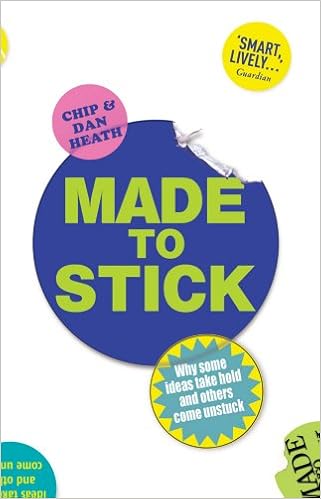
Many of these ideas been taken from an advertising book called "Made to Stick" by Chip and Dan Heath, (2008),"Made to Stick" by Chip and Dan Heath, (Publisher: Arrow (7 Feb. 2008), who also have a web presence and website at http://heathbrothers.com/books/made-to-stick/


The Oxford English Dictionary's new word of the year is "post-truth".

2) again thinking about people, people are great at visualising things. Therefore consider, what is the pain that you are going to come to cure with your solution? And also, who will you fix with your solution?

Tell your audience about a problem, something that they can readily recognise and identify with, and turn your own problem into an issue for them; Capture their emotional hearts by tugging at their metaphorical heartstrings.

Relate your conversation to diverse audiences by selecting real or imaginary people who are different, but who the audience can relate to on a personal level.

3) Building a case
Consider the classical Greek rhetorical devices;
  • Bring your facts to life.
  • Statistics and evidence win a logical mind.
Compare statistics and if necessary exaggerate, by making big numbers digestible by placing them and juxtaposing them in context with something familiar and reducing problems down further and further, e.g. Reductio ad absurdum.
  • Use vivid language to build a mental picture.
  • Use visual linking to metaphors through props and images.
  • Create these analogies and metaphors by making hooks to get above the topic or issue, by process of abstraction.
  • Consider the use of third parties; that provides evidence of success, case histories validation, and credibility.
4) Convince!
  • Use rhetorical questions. "Who doesn't love a rhetorical question?"
  • Recap - Through the presentation, especially to if it is a long one, to give some space to the audience to allow them to think again.
  • Use reiteration. Create a series, as a streamed reiteration, list the issues out.
  • Use triples or the rules of three; human beings seem to have an ability to put things together in threes. Exploit this behavioural characteristic.
5) Closing.
  • Never forget to ask what is next?
  • Build confidence around your product or idea by including at least one of these themes as your final slide; 
    • a list of short milestones; 
    • some testimonials; 
    • or a specific question 
    • e.g. "what's next?"

Conclusions;

  • Building a good pitch or presentation can often be quite daunting, particularly if it's felt that the outcome may be subjective.
  • With a clear structure to a pitch or presentation, the tools that have been provided today will help a great deal in bringing confidence not only to a future audience but also to the presenter.
  • Many of the ideas that Dan presented in this lecture can be applied in one-to-one discussions with people, and it should not be forgotten that critical conversations, if structured and planned beforehand can equally result in your own individual desired outcomes.
In my own case, I often fail to think carefully about my desired results before engaging in conversations, and I particularly like the idea of considering your own selfish aims (perhaps this itself is controversial?), before making a pitch.

References;


  • Lecture bt Dan Ramsden of the BBC, University of Huddersfield, 15th February 2017.
  • Heath, C & D, "Made to Stick" (7 Feb. 2008), Arrow, London. ("Made to Stick" by Chip and Dan Heath, (Publisher: Arrow (7 Feb. 2008),)
  • http://heathbrothers.com/books/made-to-stick/
  • See also http://heathbrothers.com/ for a great resource on Decision Making, Change Management and "Sticky Ideas".


Tuesday, 14 February 2017

Further thoughts the lecture and workshop by Sara Nesteruk (Friday, 10 February 2017) University of Huddersfield.

Thinking a little bit more about the ideas of inspiration and creativity, I recall that one of the questions that Sara posed to us was how do we create our own productive space?

The moments of insight often occurs when we least expect it.

In Sara's case, she referred to a book by Rainer Maria Rilke, in which she gets lots of inspiration from. Ostensibly, within the book, he's asking and pointing out "do not look outside yourself for inspiration, but keep looking inside for it is there that you will find it." For example, Sara randomly picked a page from the book which read;
"I would like to beg you to have patience and consider problems like locked rooms waiting for some translation".

I particularly like the idea of using text to find inspiration, this fits nicely with my own practice at the moment and my choice of using JA Baker's "the Peregrine" (1968), but equally I understand the point that each of us needs to find inspiration from any source.

A further suggestion was made to consider the book "Blink" by Malcolm Gladwell. This is a book about intuition and where we seem to find that component of our lives. Our immediate responses to situations, whether they are spontaneous bringers of joy, or alternatively situations that require some form of problem thinking, are what Gladwell explores. He goes on to say that our immediate responses are usually the most effective.

Therefore quite clearly, when one needs inspiration, the active "doing" provide us with inspiration in itself. In other words, make work for yourself!

On the subject of readings, another recommendation was made called "The Artists Way", which totally encourages the activity of writing, before picking up the paintbrush, or beginning to sculpt or make. This book is useful to help us get "into the zone".

Perhaps in thinking about this, it is useful to step backwards and ask oneself "what do you do when moments of inspiration hit you?".

Maybe, by processing thoughts from elsewhere, new ideas can come forth in entirely different manifestations.

Spontaneity is a vital step. The suggestion of writing before making can be inspired by simply thinking about three separate topics, things, or themes that generally inspire you. In my own case, the three things that inspire me and have full resonance are;
-drawing, particularly with a sketch pad and pencil.
-The drawings of Leonardo da Vinci, and almost all the other great masters.
-Open spaces. And what I mean by that are areas of land that do not have the regular and constant footfall of mankind. The Moors on my doorstep particularly fall into this category.

I also took time out to look at the TED talk created by John Kelly, which was his final video submission to the Royal School of Art, and then further submitted to the TED talks, entitled "Procrastination".

I found this to be incredibly insightful, he absolutely captures the artist's sense of fear of failure through "trying to avoid the inevitable", which is rooted together with the thoughts of being afraid to even finish something, once making has started! This video in itself is sufficient inspiration to simply get started! I think it is useful to make a direct link to it on this blog so that I can repeat it to myself, almost like a daily mantra, particularly when I'm suffering from procrastination.


Monday, 13 February 2017

Inspiration... The battle within! - Reflections on an interesting Workshop, (with Sara Nesteruk, UoH)

Friday's workshop was quite an epiphany; a magic moment for me!  It seems that the more I try to work out a process for my creativity, the more I am led to writing about it. Which is leading me to think that perhaps my real practice is in the writing of it, itself!...

Sara's workshop opened with a suggestion that when searching for inspiration, a first step that she finds helpful is to just start writing.   Write about anything from within!

The first step in the exercise Sara set, was for us to write for approximately 30 minutes, and then to pause, Step 2; go and look at something completely detached from what we have written, write about that, then Step 3; reflectively write up on the whole experience.  

So this is the outcome of these exercises below;

Step 1.  

Just looking out from within and writing my thoughts;

------------------
[A title?] -  Winter

My mind is wandering through the valleys and hills of North Yorkshire. Or a typical English landscape with hills and meadows.

There is a Skylark flying high above, making its usual trill of random notes, which gracefully swishes across the canyons and lowland streams.  How is this tiny creature here at this time of year? – Where does it take shelter from these freezing winds and hailstones?

My heart is racing through the strenuous walk. The breath of my existence is tangible almost, through the vapour clouds that flow from my shivering mouth. My arms are heavy with the coat I wear, but my legs are strong and ready for the remainder of the climb.  Looking down, half way up the mouth of this valley, I see a child’s magical re-assembly of their image of winter. The Snowman seems to beckon me with his branching twig arms towards an unknown liminal space of white nothingness.

The stone wall; that black lichen covered permanence of man's presence thrusts itself through the snow. The black smog of two hundred years of toil and fires from the cities has engulfed the rock and grit so tightly in its grasp. Blades of frozen glass shards of translucent green, wisp and rattle against the base of the walls, the delicate grasses have the strength to endure the coldest of winter days and writhe in unison as flurries come and go.

The Skylark’s sweet tune is fading now.  My arms and hands are cooling in the blustering wind. Time to move.

Walking further on the mud trodden path, now frozen in staccato patterns of sheep foot holes of recent passage. My boots skid across the mesh of open treads, loosing grip, though, being unable to ride the leaf-thin film of wet thawing ice between foot and hardened mud.

The air is thin, my coat blows cold, it’s chip, flap, flap, flapping against my chin and red raw cheeks.  I pull my hat lower.  My head is light and empty of thoughts, just bearly able to make out a distant tune of the skylark.

Far below, the wisp of smoke rises from a remote farmhouse. I imagine the roaring fire within. Big armchairs; a dog lying across the hearth maybe.  
Warmth.  
Warmth is what I need. The cold air is biting me from above and from the end of my fingers, now numb with the grip of the salutation and greeting with Jack Frost.  The snowman looks distantly on at me, with indifferent curiosity.  Why would anyone be out here in this temperature?

We share something in common, that child’s nod to winter, and I.  We are both alone.  Far from anyone to hear us moan or curse this wretched cold.  I’m low and deep in thoughts of nowhere at all.   But then my spirit is lifted again.  The distant call of the Skylark comes back into zone.  Mood lifts and falls, and lifts again like the rolling of the sea.

I must keep going.  Where is my goal? – I have none. It is the journey that is the goal, my likely finishing point will be where I started.

It always is.

I will come full circle, but the warmth of knowing the journey’s nuances makes it all worthwhile. I will make some fire when it’s dark and start again when I have eaten and slept.

But where? Where can I sleep in this cold?


My sleep will last forever, but the journey is just a fleeting passage of time that I must savour.  Sleep will erase so much…
---------------
32 mins.
---------------

It took just over half an hour for me to write that short passage, no doubt influenced by both the time of year and my walk into the studio, and moreover, the quick sketch that I made while killing some time earlier at lunch that day.

 It's satisfying that I can imagine narratives quickly, but the process of drawing from imagination seems so much better if accompanied by writing too.  I'm pleased with this approach and will adopt it more generally.

And then on to Stage Two.  
I spent 15 - 20 minutes in the library, and semi-randomly selected a book by the Getty Museum (a Guercino Catalogue), I randomly found a sketch of a landscape with a sea jetty and stonework, that instantly caught my attention;

Guercino (Ca 1635), Landscape With a View to a Fortified Port. Pen & Brown Ink,
Los Angeles, J.Paul Getty Museum, 85.GA.408. 

Guercino – Sea Scape and Castle (Casa Gennari)
 Guercino’s use of subtle shading that brings out shadows and contours of light makes the line drawing effuse a sense of calm. The promenaders on the jetty are both captured in a moment of work in the foreground, but idle strolling in the mid vista.
The arches under the jetty are suitably void of detail, but provide a structure and scaffold for the drawing to rise out of the calm waters. 

The tower is skewed towards the right, suggesting that the artist was not necessarily directly in front of the drawing (pad or easel), but to one side; therefore unable to immediately see the perspective of the architecture.

The two boats in the centre of the picture are neither tethered, nor in motion, but an oarsman is clearly seen pulling a punt to stabilise the ship as his mate draws a rope towards the bow of the boat.

Under the central archway, the light of the outer sea creates a shadow filled silhouette of a recently arrived skiff. Strangely, though, there is no reflection from the water below the boat, yet there is a reflection of the archway above.  It is evident from this alone that the sketch was made 'in the moment'.


Stage 3.

(5-10 Mins);

Immediate reflections on the above writing:

The image was taken from page 71 of “Guercino, - Mind to Paper”, by Julian Brooks (2006), The J Paul Getty Museum (Catalogue), Getty Publications,  Los Angeles.

The response addresses how my interpretation of Guercino can be articulated from a critical view through Artistic discourse.  While it describes the picture’s contents, perhaps it doesn’t address what caused the original artist to stop his other activities and pause to draw this scene.  It highlights the transient nature of drawing as sketches, through the observation of missing details that speculatively may have been present, but are simply lost in time. The existence of reflections is an interesting theme that in itself suggests a temporal existence which may, or may not be present, or have existed.


The observations of social pastimes are also of interest in the drawing. There are both workers and ‘walkers’ in Guercino's sketch… Time (as in ca. 1635) was being used, but time was also being 'wasted'…
----------------

Conclusions;

In further consideration of the above, there's a strong influence of drawing being a transient, fleeting activity, in some ways, similar to that of traditional photography.  The artist's intentions to capture a moment in time is mediated by what they immediately see and choose to record; so a narrative can be both created through latent imagination or through a particular engagement. How a "scene" is described to 'another' is what is important here to me.   If a sentient being 'could' report through a visual description or narrative, how would they present such a response?

Sara's workshop was really helpful, it's a very succinct way to expand upon imagination and to create that elusive seed of inspiration.

Nevertheless, I have lots more to do, before I can say that I have achieved a level of mastery in this process!

Saturday, 11 February 2017

Some notes on the acuity of eyesight in raptors, and thinking about their perception of images in relation to our own.

In reference to a number of biological papers that I have recently been reading and thinking about, I thought it prudent to make some notes to help me build the all-important, yet elusive point of view of the Peregrine, and here I am talking about that same Peregrine that JA Baker chose to observe for over 10 years, back in the 1950s and 60s.

My source for these notes have come mainly from an American group, "The BioMedia Association" who have placed some valuable material directly online (the details of which can be found in the References section below). This has been supported by work from Vance A.Tucker, who interestingly, being based at Duke University, is located in North Carolina, US: whereas The BioMedia Association is based in South Carolina, US. I wonder if there is a link? Anyway onto my notes…

Raptors or birds of prey, including the eagles, hawks and falcons have up to eight times more clarity of sight than the human eye (with 20+ 20+ vision). A golden eagle, for example, can see a rabbit from a distance of over one mile. The Raptor’s sharp vision is also related to very specific and peculiar feeding and flying patterns. (Biomedia Assoc (2013).

Vision is necessary for flight.  Without vision, birds cannot fly as they are unable to make directional reference sufficiently for both take off and sustained flight. Predatory evolution and feeding habituation, particularly on smaller rodents, vertebrates, invertebrates and aquatic species necessitated a more efficient method of capturing such prey. Favouring high vantage points, flight (initially through gliding) became the norm for these raptors; they also needed abilities to see at close range, and they needed to maintain focus at high speeds when in pursuit. The most successful birds of prey in any population were those with eyes better adapted to these demands. Over thousands of generations, natural selection led to populations of predator birds with greater visual capabilities. Biomedia Assoc (2013), Tucker, V.A. (2000).

According to Tucker, there are two regions of the retina found in raptors, that account for the significant increase in accuracy of vision. These are discussed as the primary fovea, or the shallow fovea, where the receptors of the retina, while pointing forward within the skull, overlap at approximately 15° to the right or left of the head axis. This shallow fovea is not too dissimilar to that found in other animals. Whereas the secondary, or deep fovea, again pointing forward in the skull within the line of sight, also has a range of approximately 45° to the right or left of the head axis. Furthermore, the central beak of the bird, lying symmetrically on either side of the head axis, creates a reference line. (Tucker, V.A.(2000)).

How do predatory birds see more sharply than us?
 All raptors characteristically have large eyes. With a greater opportunity to allow light to enter into the eye chamber (e.g. as a ‘camera’), they also allow for a larger image to be projected through the lens into the rear of the eye chamber. If a retinal image is spread over a greater number of visual cells; it necessarily follows that there will be higher resolution to the detail in the picture.
Bird's eyes are so huge that a significant portion of the skull is devoted to them, allowing only limited room for the brain. Biomedia Assoc (2013).   Nevertheless, memory, recognition and cognition play an important part in the successful functioning of the organism.
A bird in flight, hunting small prey must not only be able to distinguish how far away the prey is but also its size, shape, position, and motion. In response to these challenges, raptorial birds also evolved precise accommodation and binocularity. (2013).

Accommodation
To determine the size and distance of prey, predators rely on memory as well as visual information. Through recognition (memory) it is possible to determine (through recall) how large the prey animal is, and then judge its distance based on the size of the image available on the eye’s retina. A clear image of the prey, no matter what its distance is also critical for the correct cognition of it. (2013).
The eye automatically focuses at a variety of distances using a natural neuromuscular adjustment called accommodation. In this process, microscopic ciliary muscles surrounding the eye alter the curve of the lens within the eye, to allow focus on objects that are far or near. Raptor’s eyes have exceptional capabilities for accommodation. Thus, as a potential prey moves closer or farther from the eagle or hawk, the predator's eyes remain focused by rapidly changing the lens curvature accordingly. (2013)

Binocularity: 
Raptors have front facing eyes. Therefore binocular vision is similar to our own. In binocular vision, the fields of view of the left and right eye overlap. Whereas, creatures with eyes on the sides of their head (especially prey animals) have low binocularity (what each eye sees overlaps very little) but high periscopicity (each eye has a full field of view) to evade predation by early cognition of threat. Biomedia Assoc (2013).

The right-eye and left-eye visual fields of a hawk overlap about 90 degrees, (in human vision, this overlap is about 120 degrees). A further adaptation in raptors - the cornea and lens are angled toward the beak to increase the overlapping region further.
Binocularity allows for stereoscopic vision, which in turn permits the determination of distance. When an organism compares the slightly different images from the right and left eye, the brain is capable of automatically determining the distance to the object. Raptors, with their greater amount of visual field overlap, have the most significant abilities to use binocularity to develop a sharp, three-dimensional image of a large portion of their view. Biomedia Assoc (2013)

The Deep, or 'Second' Fovea:
In birds that need accurate distance vision, (i.e.: birds of prey and some other species), a second fovea evolved in the lateral part of the retina. The fovea is a small region of the retina where the concentration of rods and cones is highest and therefore vision is at its sharpest. Raptors, with their broad binocular field of view, have both a central and lateral fovea. As a result, a substantial proportion of their visual field projects to the most visually sensitive parts of the retina. Tucker, V.A, (2000) & Biomedia Assoc (2013)

Pecten:
Another unique structure found in almost all bird species eyes is the pecten. Pecten is a thin, greatly folded tissue extending from the retina to the lens. Predatory birds such as eagles and hawks have the largest and most elaborate pecten. This unique structure supplies nutrients and oxygen throughout the vitreous humour of the eye, thereby reducing the number of blood vessels in the retina. With fewer blood vessels to scatter light entering the eye, raptor vision has evolved to be the sharpest image known among all organisms. Biomedia Assoc (2013)

Conclusions;

In thinking about my readings, I undertook a few weeks ago (concerning ancient Egyptian mythology). Concerning the god of the sky "Horus", I find it quite surprising that those ancient Egyptian thinkers and particularly the "priests" or shamanic leaders chose the Peregrine Falcon as the symbol of the God of all gods, and great overseer. How did they know, over 5000 years ago, that this simple bird of prey was indeed, not simple at all!

It is fascinating that science only over the past hundred or so years is now able to prove the observations that those ancient Egyptians were able to recognise 5000 years earlier. The myths of Egypt's heritage hold Horus, (usually depicted in human form but with the head of the Peregrine Falcon) as the highest deity, and it is from their original notions that the all seeing eye has been reinterpreted, indeed re-conceived, throughout the ages. The concept extends to almost all the major religions.

My determination to stay with the original project ideas seem to be continually reinforced.

References;

Notes recorded from material provided by
 BioMEDIA ASSOCIATES, LLC (2013), Beaufort, South Carolina, US.
(LIMITED EDUCATIONAL USE MAY BE ALLOWED) https://www.ebiomedia.com/
Tucker, V.A. (2000) “THE DEEP FOVEA, SIDEWAYS VISION AND SPIRAL FLIGHT PATHS IN RAPTORS” Department of Biology, Duke University, Box 90338, Durham, NC,
in The Journal of Experimental Biology 203, The Company of Biologists Limited, Great Britain  (pp 3745 – 3754).

Friday, 10 February 2017

Bringing order to chaos, part two.

Following the last meeting after the BBC lecture, at least we were able to start to flesh out roles and responsibilities of each of the individual students. Thankfully, we were able to do this with the help of Dr Bailey, as I'm still finding my own feet within the group and gaining their trust before making the stronger move forward to try and lead them.

I am pleased that my preparatory work in documenting roles and responsibilities for the team last week has been met with positive feedback. The team have appointed me as the group facilitator and project lead, but I have been quick to try to correct team members from calling me boss! I am merely the hands that provide coordination, and I'm keen to ensure that there is no hierarchical behaviour in this collaborative group. Nevertheless, I think everybody recognises the need for a spokesman, and I'm happy to have adopted this role too.

So now we have clear terms of engagement, together with a better understanding of expectations from what I have started to call "our client" Dr Devlin, I have started to write a short statement which reflects those understandings back to him, in our own language. I think this two-way communication between ourselves as a delivery team, and our client, makes for a much better foundation to work forward with.

Within this memorandum of understanding (MOU), I have also articulated some boundaries on the work that the students are expecting to do. Whilst these boundaries are still loose and somewhat flexible, they do set some conscious limits within the relationship, so that our client does not start to grow his own expectations out of proportion with what the team is capable of delivering, within the timescales. This is a typical project management tool and is often referred to as an MOU, whereas a more detailed and specific planning document tends to be referred to as a Statement of Work (SOW).

I need to be careful not to introduce too many project management jargon terms that people both within the group and outside may not fully understand, but I do have the advantage of calling on my experience to help the team activities stay focused, as well as maintaining a positive mental attitude.

As the first opening event is due to take place on Thursday, 16 February, I intend to informally present the MOU to Dr Devlin for him to read at his own leisure. He will have too many things on the opening night to discuss this I suspect, so I will try to engage in further discussion with him the following week to confirm his expectations meet our own.